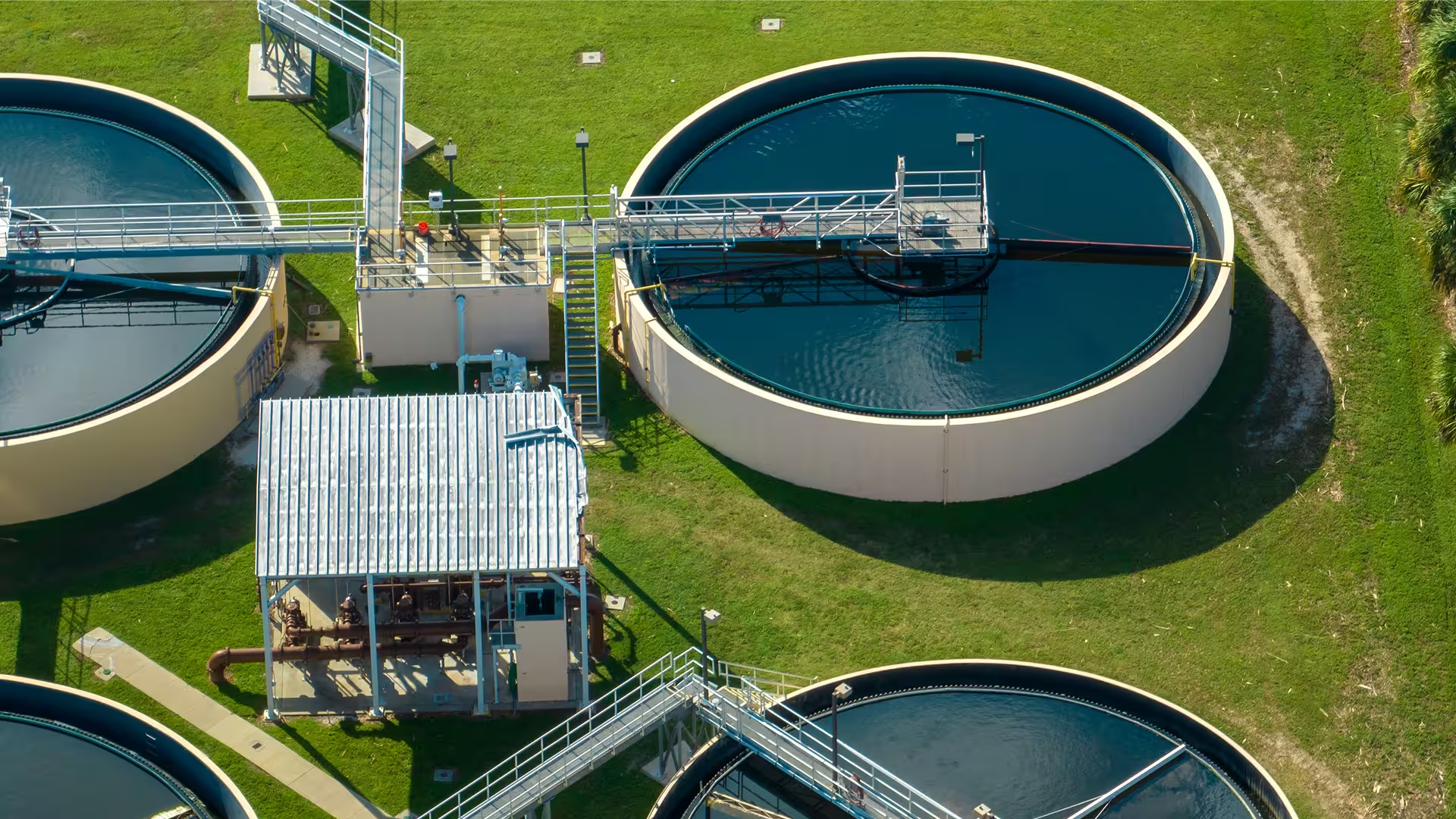
Aerial view of a wastewater treatment plant showing multiple large circular sedimentation tanks filled with water, connected by metal walkways and surrounded by green grass.

Receiving and Pretreatment Facilities for Hauled Non-Hazardous Liquid Waste

BlueGate Infrastructure develops and operates private receiving, pretreatment, and recycling facilities for hauled non-hazardous liquid wastes including grease trap, septic, and vactor waste.
BlueGate facilities condition high-strength waste streams upstream of municipal sewer systems and discharge only pretreated effluent under permit. Grease trap waste is recycled: recovered brown grease becomes renewable fuel feedstock instead of entering the sewer or a landfill. This approach complements local wastewater infrastructure and reduces FOG, grit, solids, and BOD loads on collection and treatment systems.
Aerial view of circular water treatment tanks with metal walkways and railings, part of an industrial water treatment facility.
System Context

An Infrastructure Gap in Hauled Waste Receiving

Grease trap waste, septage, and vactor waste are a persistent operational challenge for municipal sewer systems and wastewater treatment plants (WWTPs).
Untreated, these streams carry FOG, grit, solids, and BOD loads that drive blockages, sanitary sewer overflows, pump station failures, and treatment upsets.
Stricter grease trap enforcement, septic pumping, and sewer and storm system maintenance have increased hauled volumes. Many POTWs were not designed to receive high-strength or high-solids hauled waste and face capacity, odor, and operational constraints.
Limited receiving infrastructure forces haulers to travel long distances or concentrate loads at a small number of facilities.
Load impacts on sewers & WWTPs
FOG, grit, and solids: blockages, overflows, pump failures
Rising hauled volumes
grease trap enforcement, septic pumping, sewer and storm maintenance
WWTP constraints
capacity, operational, and compliance pressure
Hauling inefficiency & risk
long travel distances, limited receiving hours, concentrated loads
Lost feedstock
brown grease goes to the sewer or a landfill instead of being recycled into renewable fuel feedstock
Waste Streams

Three Non-Hazardous Streams, One Receiving Point

BlueGate facilities receive and pretreat the high-strength hauled wastes that municipal systems are least equipped to handle.
Grease Trap Waste
Pumped from food service grease traps and interceptors. Recovered brown grease is recycled into renewable fuel feedstock.
Septic Waste
Septage pumped from residential and commercial septic systems
Vactor Waste
Liquids and solids from sewer line cleaning, catch basin and storm drain cleaning, and hydro-excavation
BlueGate accepts only these three streams. Hazardous waste is not accepted. Acceptance of each load is subject to facility permits and waste acceptance criteria.
Approach

Stand-Alone or Co-Located Receiving and Pretreatment

Facilities use engineered, purpose-built pretreatment systems and are located strategically near major waste-generation nodes, while remaining aligned with municipal capacity and permitting requirements.
BlueGate facilities are designed to support existing municipal pretreatment programs and sewer use ordinances.
1
Receiving
of hauled grease trap, septic, and vactor waste, screened against waste acceptance criteria
2
Pretreatment
to remove debris, grit, grease, and suspended solids
3
Recycling
brown grease recovered from grease trap waste and recycled into renewable fuel feedstock
4
Permitted Sewer Discharge
of conditioned effluent to the sewer system
BlueGate is not a hauler. Haulers are our customers, not our competitors.

Where the Recovered Grease Goes

Demand for renewable diesel is growing faster than the supply of the waste fats, oils, and greases used to make it, and grease trap waste is a largely untapped source. BlueGate recovers brown grease that would otherwise go to the sewer or a landfill and sells it as feedstock to third-party refiners. BlueGate does not refine or produce fuel.
Positioning

A Defined Role Between
Haulers and Wastewater Treatment

BlueGate is independently positioned between waste generators and municipal wastewater systems, allowing WWTPs to retain control over discharge conditions while reducing exposure to high-strength, variable loads.
Haulers
Grease Trap, Septic & Vactor Waste
Pretreatment
WWTP
Core Wastewater Treatment
White vacuum truck parked in a lot with a large hose extending from the truck to an open utility or sewer grate in the ground near a landscaped area.
System Effects

Upstream Pretreatment
that Relieves System Stress

There are multiple operational benefits for both haulers and municipal wastewater systems, primarily by improving receiving efficiency, reducing system strain, and removing grease, grit, solids, and BOD before permitted sewer discharge. Grease trap waste is recycled: recovered brown grease is sold offsite as renewable fuel feedstock, and separated solids from all streams are sent to permitted disposal facilities.
For Haulers
Expanded receiving capacity
additional permitted receiving locations for grease trap, septic, and vactor waste
Reduced travel distances and wait times
strategically located receiving facilities for direct routing and predictable access
Cost-competitive receiving
for independent and regional haulers
Predictable & efficient
disposal operations
For Municipal Systems
Pretreated water
Reduced FOG, grit, and solids entering sewer systems lower the risk of blockages, SSOs, and pump station stress
Controlled, monitored discharge
Time controlled discharge to manage flow to collection and treatment infrastructure
Fewer truck miles
shorter haul routes reduce regional truck traffic and roadway wear
Core treatment
ability to focus on core treatment responsibilities for wastewater utilities
Grease recycled, not disposed
recovered brown grease is recycled into renewable fuel feedstock
For Utilities

Co-Located Pretreatment at Your Treatment Plant

BlueGate partners directly with POTWs to site receiving and pretreatment facilities at or adjacent to existing treatment plants. BlueGate designs, builds, finances, operates, and maintains the facility. The utility keeps control of discharge conditions and gets a new revenue source without taking on the capital cost.
No capital outlay
BlueGate finances design and construction, and carries operating and maintenance responsibility for the life of the agreement
Revenue share
the utility receives a share of facility revenues from hauled waste receiving
Digester feedstock
where the utility operates anaerobic digesters, organic-rich residuals recovered during pretreatment can be supplied as co-digestion feedstock to increase biogas production
Utility control
discharge timing, volumes, and quality remain governed by the utility’s permit conditions and pretreatment program
Relieved headworks
hauled high-strength waste is pretreated before it reaches plant processes, reducing FOG, grit, and solids loads
Engineering & Development

Experienced Design Support
for our Pretreatment Facilities

BlueGate partners with experienced engineering firms to design and deliver pretreatment infrastructure. Their expertise in wastewater pretreatment and permit-aligned design ensures facilities are engineered for safe, compliant operation.
Logo with a dark blue gear symbol partly encircling a leaf inside it, above the text 'ProcessWerx' with 'Process' in regular font and 'Werx' in bold.
ProcessWerx, BlueGate’s design-build engineering partner, has designed, built, and commissioned 20 grease trap waste recovery and recycling facilities in the U.S. Its expertise in pretreatment system design helps ensure BlueGate’s facilities are engineered, compliant, and aligned with municipal requirements.

Regulatory Framework

Permitted Operations with Municipal Oversight

BlueGate facilities operate under applicable local and state permits. Municipal oversight is maintained through permit conditions and reporting requirements.
Only pretreated effluent is discharged to the municipal sewer
Discharge occurs through permitted connections and sampling manholes
Effluent meets applicable local pretreatment standards
Operations are designed to avoid shock loading and uncontrolled discharges
Monitoring, sampling, and reporting are conducted as required by permit
Incoming loads are screened against written waste acceptance criteria; hazardous waste is not accepted
Accepted streams are tracked by load manifest
Grease trap waste is processed for recycling, with recovered grease volumes tracked and reported
Ownership & Inquiries

About BlueGate

BlueGate Infrastructure is backed by Clarence Capital Partners, a private investment firm focused on infrastructure and essential services.
For inquiries related to municipal coordination, hauling partnerships, or general information:
Aerial view of a water treatment facility with multiple rectangular concrete tanks and metal railings.
Current Phase

Development-Stage Platform

BlueGate is currently in the development phase.
Initial projects are under evaluation or negotiation
Facility development is proceeding in coordination with municipal, regulatory, and operational stakeholders
Modular facility designs are planned, with the ability to scale over time as permitted and needed